
Johnathan Doe
Founder & CEO

Johnathan Doe
Marketing Head

Johnathan Doe
Finance Head

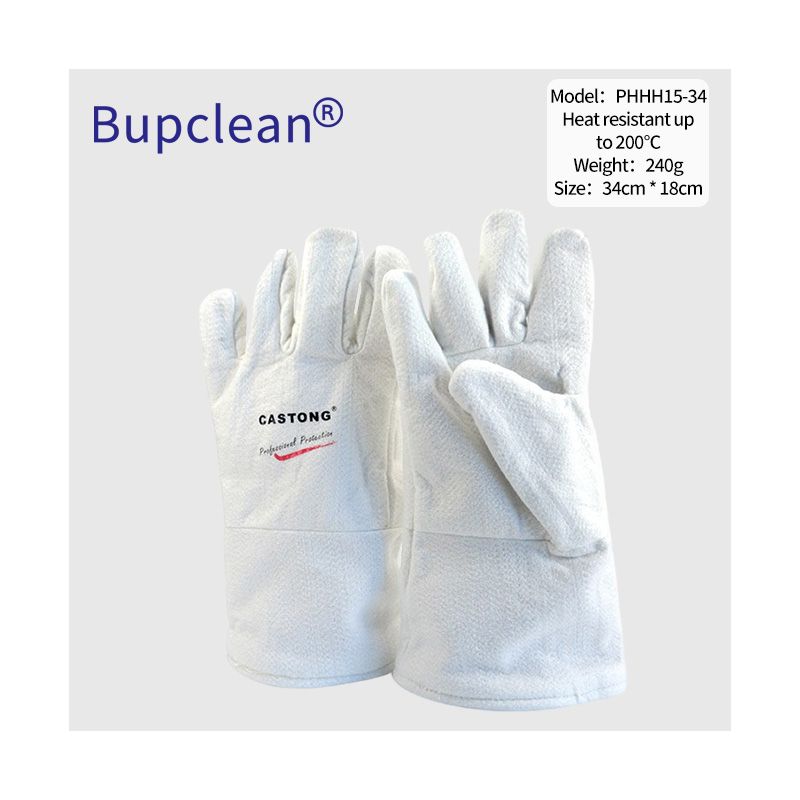
Bupclean® heat resistant glove model PHHH15-34. Withstands up to 200°C. Weight 240g, size 34cm × 18cm. Ideal for high temperature handling in labs, kitchens, and industrial settings.
We are committed to delivering five‑star service across every product we offer — from responsive support to reliable delivery and beyond. Your satisfaction is our benchmark.
| Parameter | Value |
|---|---|
| Brand | Bupclean® (CASTONG® Professional Protection) |
| Model | PHHH15-34 |
| Max continuous temperature | 200°C (392°F) |
| Material | High temperature resistant fabric (e.g., aramid blend or coated cotton – typical for this range) |
| Weight | 240 grams (per pair) |
| Length | 34 cm (13.4 inches) |
| Width | 18 cm (7.1 inches) |
| Cuff type | Straight cut, extended coverage |
| Color | Typically grey or khaki (heat resistant coating) |
| Packaging | One pair per polybag |
| Standards | CE EN 407 (heat protection) – likely compliant, verify with supplier |
1. Heat resistance up to 200°C
This glove is designed for intermittent handling of objects at 200°C. Do not exceed 200°C or use for prolonged contact with molten materials. Typical performance:
| Temperature | Safe contact time (seconds) |
|---|---|
| 150°C | 15 – 20 seconds |
| 180°C | 10 – 15 seconds |
| 200°C | 5 – 10 seconds |
2. Lightweight design (240g per pair)
Compared to heavier gloves (300–500g), this glove reduces hand fatigue while still providing adequate protection. Operators can work longer without removing gloves.
3. Extended length (34cm)
Provides coverage beyond the wrist, protecting the forearm from hot surfaces, splashes, and radiant heat.
4. Good dexterity
The 18cm width allows for a comfortable fit for average to large hands. The material is flexible enough to grip hot test tubes, handles, and small parts.
5. Multi‑layer construction (typical for this type)
Outer layer: Heat reflective or flame retardant fabric
Middle layer: Thermal insulation (e.g., foam or felt)
Inner layer: Comfort lining (cotton or aramid)
| Industry | Typical use |
|---|---|
| Laboratory | Removing hot glassware, beakers, metal racks from autoclaves, ovens, drying chambers |
| Food processing | Handling hot trays, oven doors, grill grates |
| Industrial | Injection molding machine nozzle cleaning, hot plate handling |
| Electronics | Soldering, rework on hot PCBs (brief contact) |
| Home / kitchen | BBQ, wood stoves, hot pots |
Not recommended for: Molten metal, direct flame contact, cryogenic temperatures, or electrical insulation.
Our clients from semiconductor, pharmaceutical, medical device, and aerospace industries trust our cleanroom wipers for consistent performance, high absorption, and low particle generation. Here’s what they have to say.
Founder & CEO
Marketing Head
Finance Head
We have broken down the core products and actual test data into a clear, at-a-glance comparison table across six industries (semiconductor wafers, OLED panels, precision optics, biopharmaceuticals, automotive electronics, and new energy batteries). The table includes the wiper or cleanroom consumable model for each industry, key physical parameters (particle shedding, water absorbency, ionic residues, etc.), and applicable compliance standards (SEMI, GMP, IATF 16949, ISO 10993, etc.)
Industry Resources: