Cleanroom swabs are essential for contamination control in semiconductor, pharmaceutical, and medical device manufacturing. This comprehensive guide covers cleanroom swab types, materials, applications, and selection criteria to help you choose the right tool for your critical environment.
Introduction: The Hidden Threat of Contamination
In semiconductor fabrication, pharmaceutical production, and medical device manufacturing, the smallest particle can cause catastrophic failure. A single speck of dust measuring just 0.1 microns can render an entire microchip non-functional, leading to millions of dollars in losses. One study indicates that 50% of yield loss in semiconductor manufacturing is caused by micro-contamination.
This is where cleanroom swabs become indispensable. Unlike ordinary cotton swabs found in households or general laboratories, cleanroom swabs are precision-engineered cleaning tools designed to remove contaminants from critical surfaces without introducing new particles, fibers, or residues. They are manufactured in controlled environments, undergo rigorous testing for particle shedding, and are formulated to meet the strictest industry standards.
Cleanroom swabs play a critical role across multiple industries, including semiconductor manufacturing, pharmaceuticals, biotechnology, aerospace, medical devices, and precision optics, where even tiny particles or contaminants can cause significant defects or compromise product quality.
What Are Cleanroom Swabs?
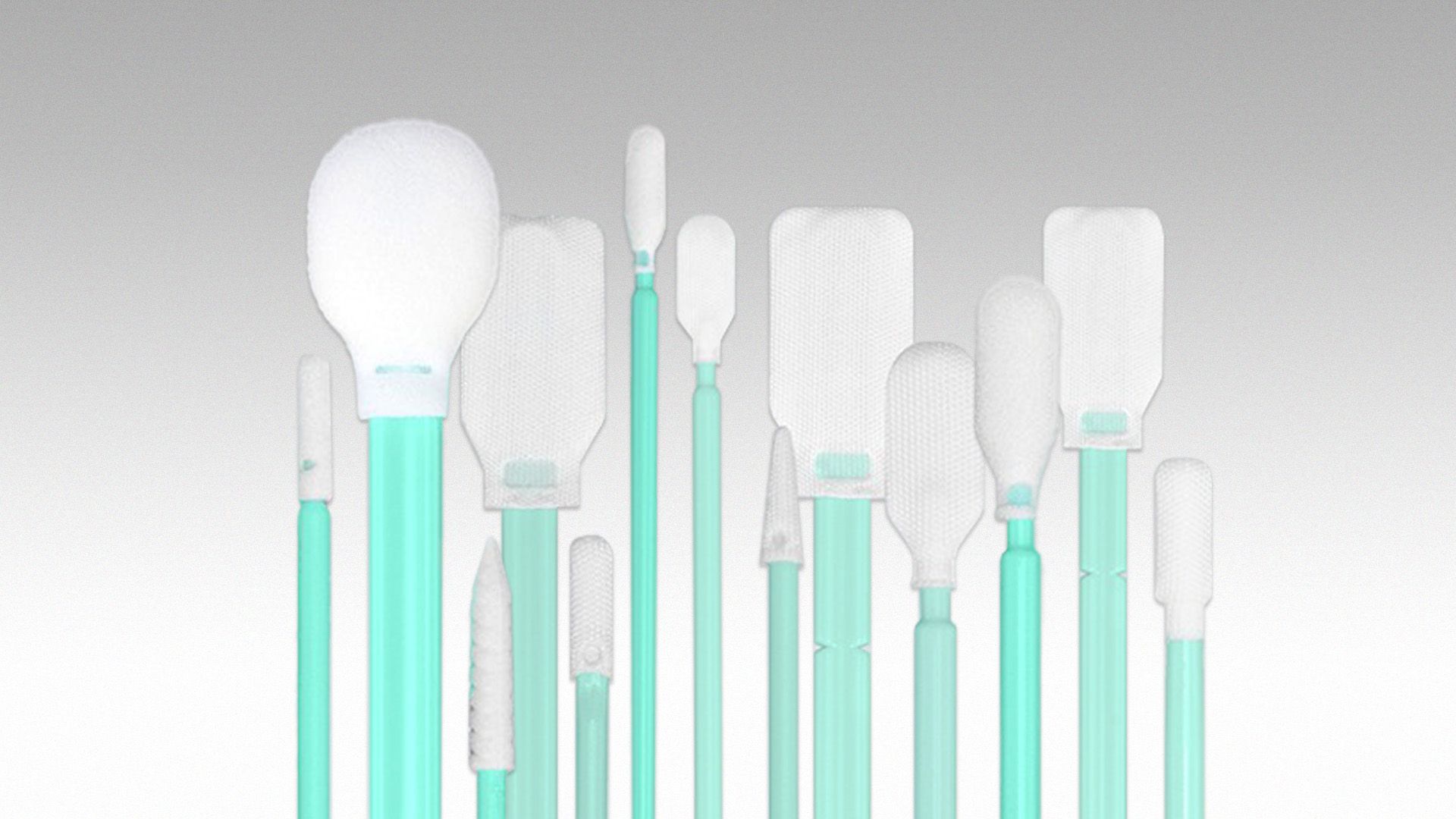
A cleanroom swab is a specialized cleaning tool consisting of two primary components: a handle (shaft) and a tip (head). The handle provides ergonomic control and access, while the tip is crafted from low-linting, high-purity materials engineered for specific cleaning and sampling tasks.
What sets cleanroom swabs apart from standard swabs is their controlled manufacturing process. They are produced in ISO-certified cleanrooms, utilizing automated processes that eliminate adhesive contaminants and reduce material shedding. They are designed to control:
Particle shedding
Non-volatile residues (NVRs)
Ionic contamination
Electrostatic behavior
Unlike standard cotton swabs that can leave behind lint and fibers, cleanroom swabs deliver residue-free performance, ensuring they won’t introduce contaminants back into your critical environment
Types of Cleanroom Swab Materials
Cleanroom swabs are available in a range of materials, each offering distinct advantages for specific cleaning tasks. The primary goal of these swabs is to remove contaminants from critical surfaces without introducing new contaminants. Below is a detailed breakdown of the most common cleanroom swab materials:
Polyurethane Foam Swabs
Foam swabs are constructed from open-cell polyurethane foam, which possesses a reticulated structure designed to capture and hold particles and liquids within the foam. They are one of the most widely used types of cleanroom swabs.
Key Features:
High absorbency for both aqueous and solvent-based liquids
Low particle generation
Soft and non-abrasive – safe for delicate surfaces
Excellent solvent compatibility
Good particle entrapment due to open-cell structure
Primary Applications:
General-purpose cleaning in cleanrooms
Applying solvents such as isopropyl alcohol (IPA) and acetone
Removing excess residues from surfaces
Cleaning optical lenses and other delicate components
Surface preparation before microelectronics assembly