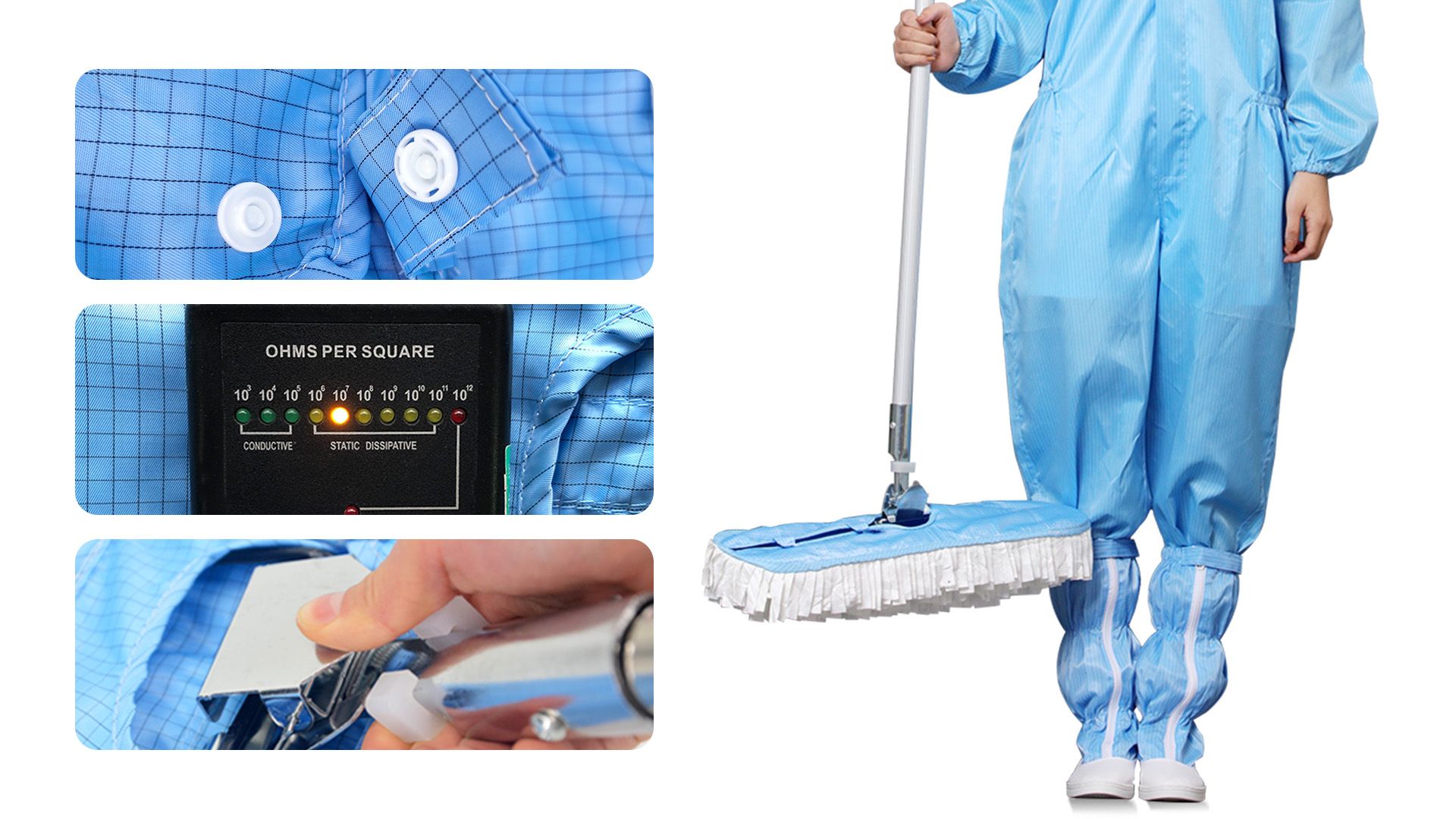
We tested three common cleanroom mop types for electrical continuity, particle generation, and cleaning efficiency. The results show that the mop you choose directly affects your floor’s ESD performance.
The three mop types tested
| Mop type | Head material | Handle material | Claimed ESD property |
|---|---|---|---|
| A – Standard cotton mop | Cotton yarn | Aluminum or plastic | None |
| B – Conductive rubber mop | Carbon‑loaded rubber | Conductive plastic | Yes – dissipative |
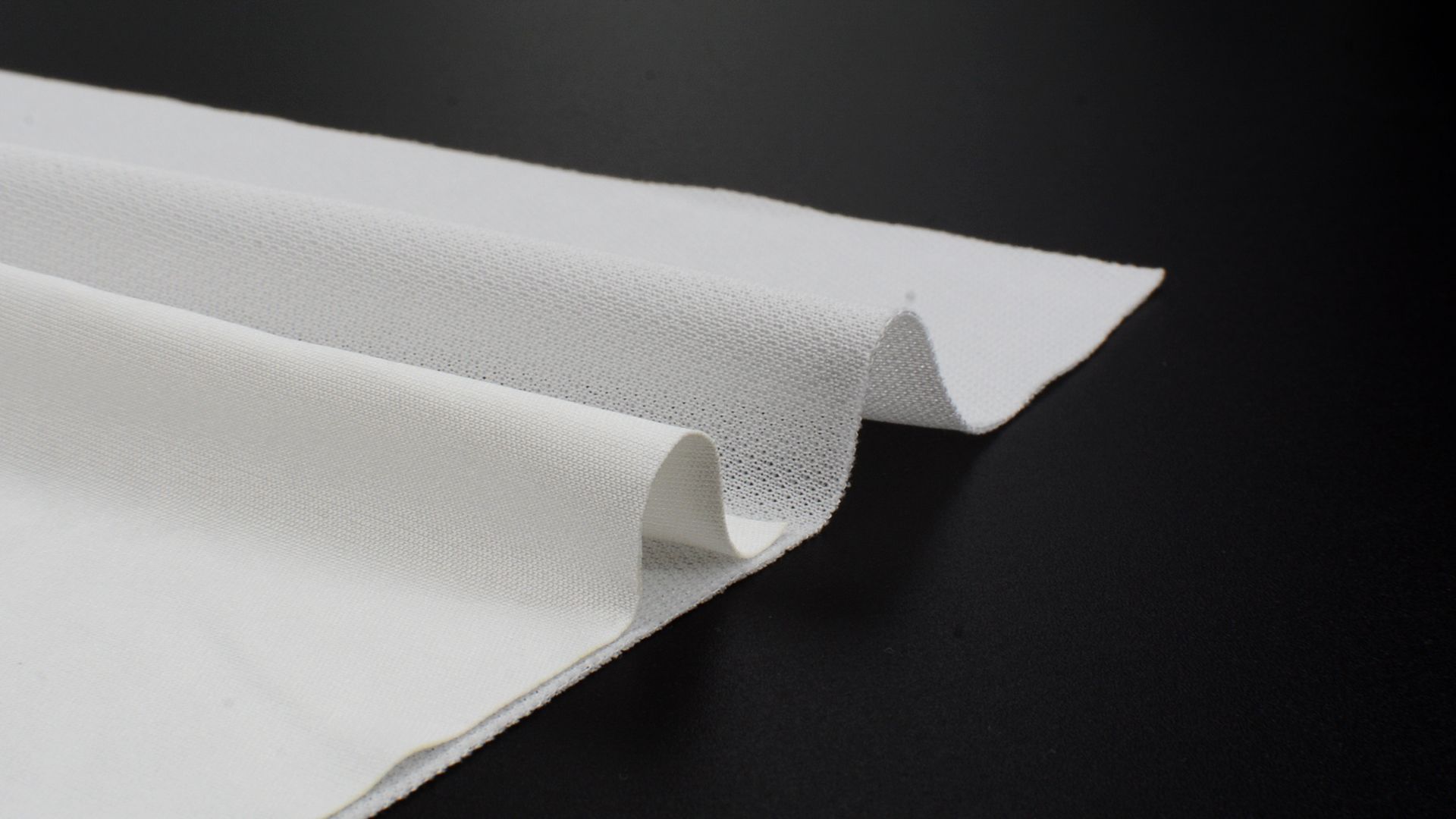
| C – ESD mesh mop | Knitted conductive fabric (polyester + carbon fiber) | Stainless steel or carbon‑filled | Yes – low resistance |
All mops were tested new, then after 10 standard cleaning cycles (water only, no detergent).
Test 1 – Electrical continuity from mop head to operator
The mop must provide a path from the floor to the operator (or from operator to ground through the floor). We measured resistance from the mop head (wetted with DI water) to a metal plate held by the operator.
| Mop type | Resistance (new) | Resistance after 10 washes | Pass/fail (<10⁹ Ω for ESD) |
|---|---|---|---|
| A – Cotton | >10¹² Ω (open) | >10¹² Ω | ❌ Fail – insulative |
| B – Rubber | 2.5×10⁸ Ω | 4.1×10⁸ Ω | ✅ Pass |
| C – Mesh | 1.8×10⁶ Ω | 2.2×10⁶ Ω | ✅ Pass (best) |
Key finding: The cotton mop is an insulator. It does not drain static; it can actually generate triboelectric charge. The rubber mop works but resistance is near the upper limit. The mesh mop provides a reliable conductive path.
Test 2 – Particle generation (during mopping)
Using each mop on an ISO 6 cleanroom floor for 5 minutes, we measured airborne particles (≥0.5μm) generated by the mopping action.
| Mop type | Baseline particles/m³ | Peak particles/m³ | Increase |
|---|---|---|---|
| A – Cotton | 35,000 | 125,000 | +257% |
| B – Rubber | 35,000 | 52,000 | +49% |
| C – Mesh | 35,000 | 42,000 | +20% |
Cotton mops shed fibers and release trapped particles. Rubber mops are low‑shedding but can leave rubber particles. The mesh mop, made from knitted fabric similar to cleanroom wipers, generates the fewest particles.
Test 3 – Cleaning efficiency (removal of oil and dust)
We applied a standard test soil (machine oil mixed with standard dust) to a conductive floor tile and measured percent removal after one pass.
| Mop type | Oil removal | Dust removal | Notes |
|---|---|---|---|
| A – Cotton | 68% | 72% | Absorbs well but leaves lint |
| B – Rubber | 55% | 82% | Good dust pickup, poor oil absorption |
| C – Mesh | 81% | 91% | Best overall cleaning |
The mesh mop combines mechanical scrubbing with good absorption. Rubber mops push oil around rather than absorbing it.
Why most cleanrooms need an ESD‑rated mop
An ESD floor works by draining static from operators and equipment through the floor to ground. But if the mop used to clean that floor is insulative, it can:
Leave a residue – Cotton fibers and detergent films increase surface resistance
Generate static – Rubbing an insulative mop on a conductive floor creates triboelectric charge
Break the grounding path – A wet cotton mop acts as an insulator, preventing the floor from draining charge
In a real EPA, the cleaning tool is part of the ESD system. Ignoring it is like installing a lightning rod then painting it with insulative paint.
A real case: Mop caused intermittent ESD failures
A PCB assembly plant had random gate oxide failures – about 1.5% of boards failed after burn‑in. The floor was conductive epoxy with copper tape. Monthly floor resistance tests passed (always <10⁹ Ω). But the failures continued.
We observed the cleaning procedure. The janitorial staff used a standard cotton string mop with a plastic bucket. The mop had no ground path. During mopping, the operator built up static charge on the mop handle. When the mop head touched the floor, it discharged – sometimes through sensitive components on the floor (if a board was waiting on a cart).
Fix: Replaced cotton mops with ESD mesh mops connected to ground via a conductive handle and a ground cord. Also trained cleaning staff to wear ESD wrist straps. Field failure rate dropped by 80% in two months.
How to choose an ESD mop – specification checklist
| Parameter | Target value | Test method |
|---|---|---|
| Handle to head resistance | <10⁹ Ω (dissipative) | Measure with 100V megger |
| Handle material | Carbon‑filled or stainless steel | Visual + resistance check |
| Head material | Conductive mesh or carbon‑loaded foam | IEST‑RP‑CC003.4 for particles |
| Ground connection | Built‑in banana jack or alligator clip | For connecting a ground cord |
| Particle shedding | ≤500 particles/m² (≥0.5μm) | Helmke drum or similar |
Using a mop with a ground cord – best practice
Even a conductive mop is not grounded unless you connect it. The simplest method:
Attach a ground cord (1 MΩ resistor optional but recommended) from the mop handle to a verified ground point.
The operator should wear an ESD wrist strap connected to the same ground.
Wet the mop with DI water or low‑residue cleaner (no wax or fabric softener).
Mop in straight lines, not circles, to avoid building static.
Alternatively, use a floor cleaning system where the mop head is wet with a conductive solution and the operator is grounded through ESD footwear and a conductive floor.