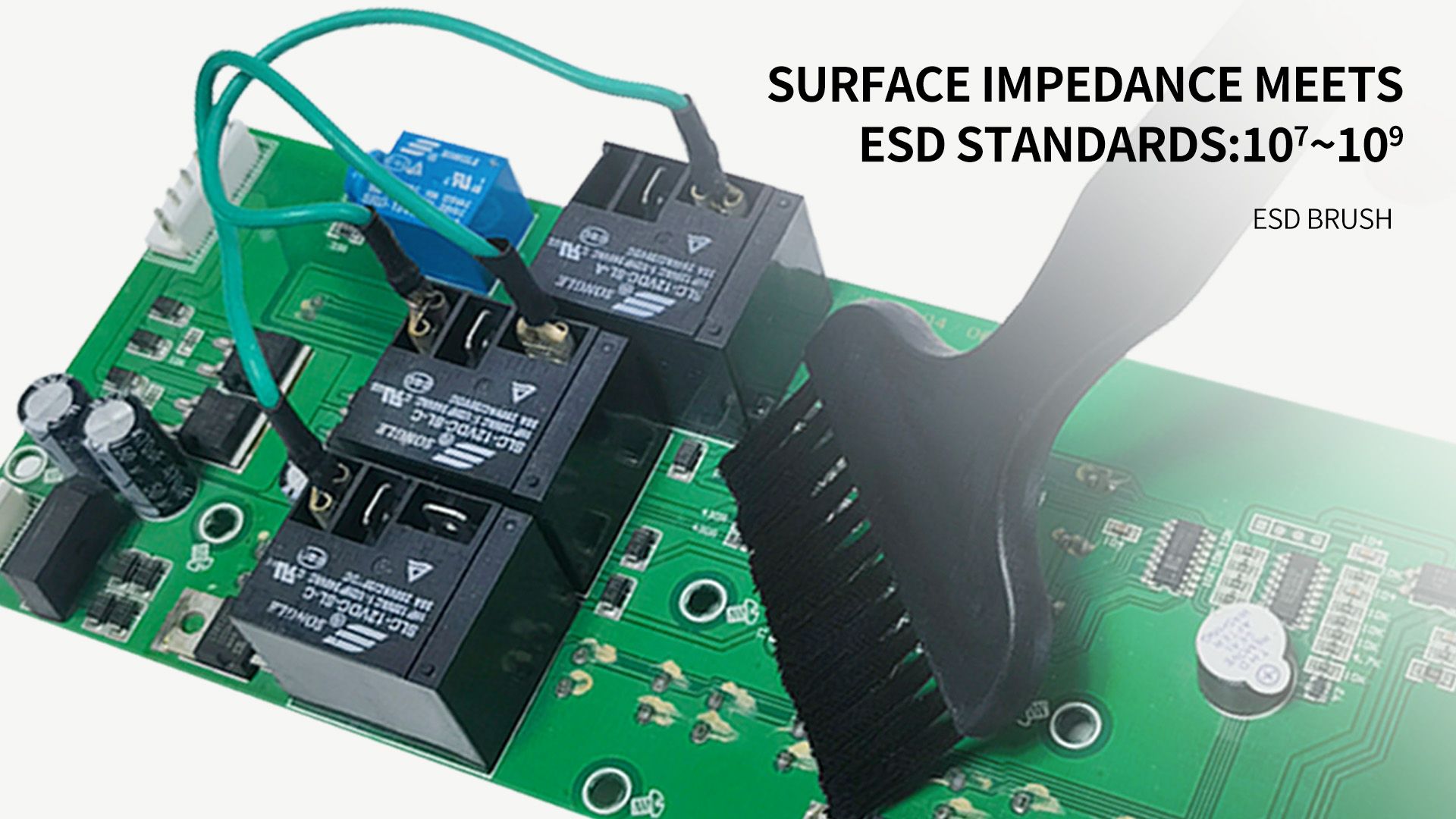
Surface impedance of ESD brushes meets 10⁶–10⁹ Ω. Why static dissipative brushes are critical in PCB assembly, wafer handling, and cleanroom cleaning. Data and applications inside.
The hidden danger: triboelectric charging
When two materials rub together, electrons transfer from one to the other. This is triboelectric charging. A brush bristle rubbing across a PCB or a chip package can generate significant voltage.
We measured brush‑generated voltage on a grounded copper plate (simulating a sensitive device) using a static meter.
| Brush type | Bristle material | Voltage generated on plate | ESD safe? |
|---|---|---|---|
| Standard brush (cheap) | Nylon | 3800 – 5500 V | No |
| Anti‑static brush (coated) | Nylon with topical coating | 800 – 1500 V | Marginal |
| ESD dissipative brush | Carbon‑filled nylon | <100 V (within 10⁶–10⁹ Ω impedance) | Yes |
The ESD brush, with surface impedance meeting the 10⁶–10⁹ Ω standard, allows static to drain slowly and safely. The standard brush acts like a capacitor, storing charge and then discharging it abruptly – exactly what kills semiconductors.
What does 10⁶–10⁹ Ω impedance mean?
Surface impedance (or surface resistance) measures how easily electricity flows across the material surface.
Below 10⁵ Ω (conductive) – Too low. May cause rapid discharge and sparking. Not suitable for direct component contact.
10⁶ – 10⁹ Ω (dissipative) – Ideal. Static drains at a controlled, safe rate. No sparking.
Above 10¹⁰ Ω (insulative) – Dangerous. Charge builds up and discharges unpredictably.
An ESD brush certified to 10⁶–10⁹ Ω ensures that any static generated by brushing is conducted through the bristles to the handle and then to ground (via the operator or a ground cord).
Where ESD brushes are critical in microelectronics
| Application | Why ESD brush is required | Typical brush type |
|---|---|---|
| PCB assembly after soldering | Removing flux residue without zapping nearby ICs | Carbon‑filled nylon, soft bristle |
| Wafer handling | Dusting wafer cassettes and carriers | Ultra‑soft dissipative brush (10⁷–10⁸ Ω) |
| SMT stencil cleaning | Brushing solder paste off stencils without static damage | ESD dissipative, solvent‑resistant |
| Cleanroom maintenance | Cleaning laminar flow hoods, equipment vents | Low‑particle ESD brush |
| Rework stations | Removing loose particles before rework | Small anti‑static brush with ground clip |
How to select the right ESD brush for your application
| Selection factor | What to look for | Why |
|---|---|---|
| Surface impedance | 10⁶ – 10⁹ Ω (stamped on brush or certificate) | Ensures dissipative, not insulative |
| Bristle material | Carbon‑filled nylon or conductive polyester | Permanent ESD property (not topical coating) |
| Bristle hardness | Soft (for components) to medium (for general cleaning) | Avoid scratching surfaces |
| Handle material | Conductive plastic or metal (with ground snap) | Allows continuous ground path |
| Cleanroom compatibility | Low‑particle, non‑shedding | Prevents contamination |
| Certifications | Test report per ANSI/ESD STM11.11 or IEC 61340‑4‑5 | Verifies impedance |
How to test an ESD brush (simple field method)
If you have a surface resistance meter with two 5‑pound probes, place one probe on the bristles (press into the tuft) and the other on the handle. Measure resistance. It should be between 10⁶ and 10⁹ Ω.
If you do not have a meter, a simple static meter can measure the voltage generated when the brush is rubbed against a grounded metal plate. A good ESD brush will generate less than 100V. A standard brush will generate several thousand volts.
Best practices for using ESD brushes
Ground the brush handle – If the brush has a metal snap, connect a ground cord to a common ground point. This drains static directly.
Use the brush only on grounded workbenches – The operator should also wear a wrist strap.
Clean ESD brushes properly – Use IPA and a cleanroom wipe. Do not use aggressive solvents that degrade the conductive filler.
Replace worn brushes – When bristles fray or fall out, the brush loses its ESD properties and may shed particles.