Double‑head swabs with low lint, high abrasion resistance, and precise cleaning for small gaps and hard‑to‑reach spots. Various styles available. Real test data inside.
What makes double‑head swabs different
A double‑head swab has a cleaning tip on both ends of the handle. This simple design change offers three benefits:
First, you get two cleaning surfaces per swab. One end for applying solvent, the other for drying. Or one end for rough cleaning, the other for final polish. This cuts swab usage by half.
Second, you reduce the risk of cross‑contamination. With a single‑ended swab, operators often flip it over and reuse the same tip. Double‑head swabs encourage using a fresh end.
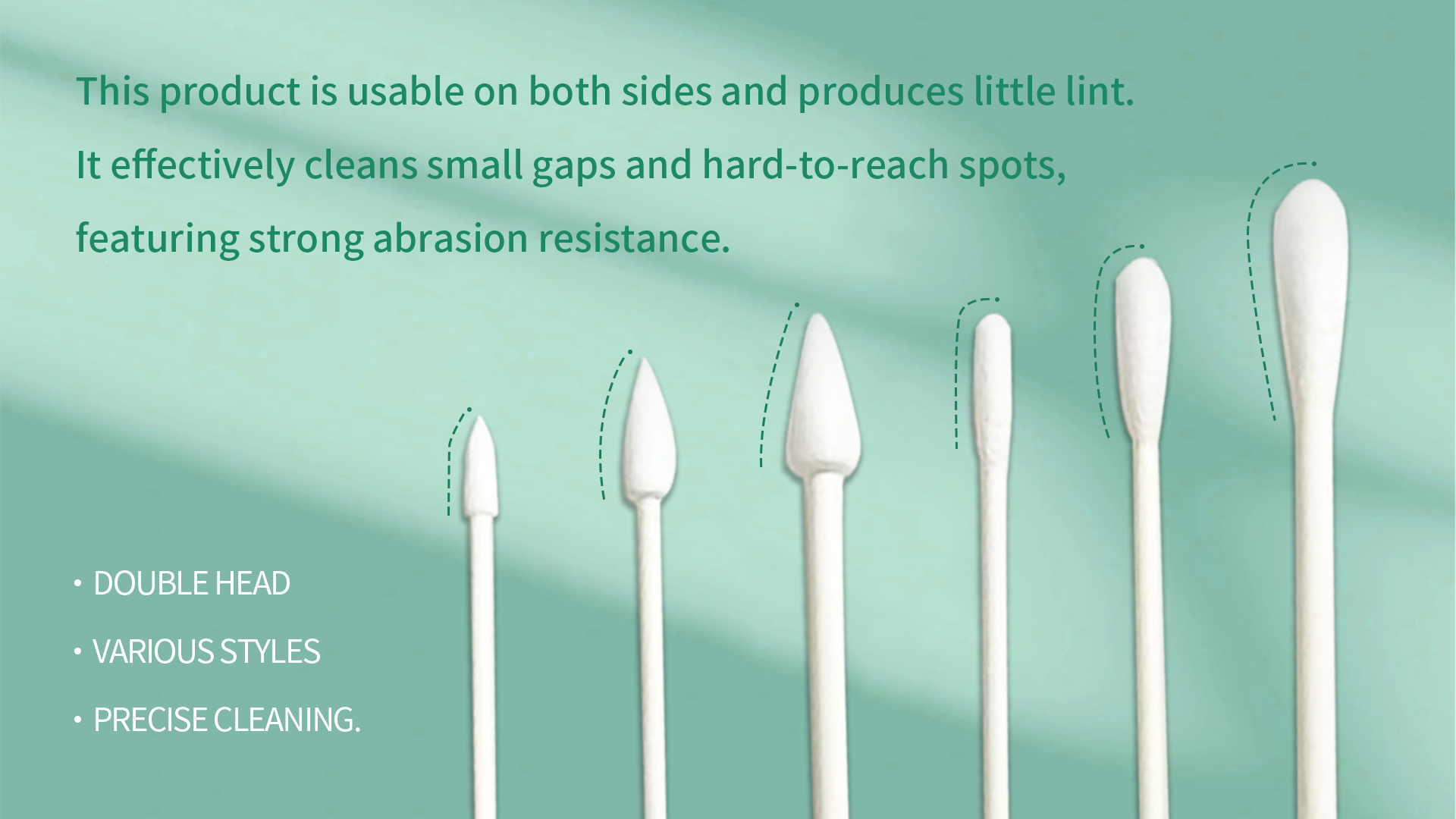
Third, double‑head swabs are designed for hard‑to‑reach spots. The tips are available in various shapes – pointed, round, chisel, flat – to fit different gaps and cavities.
The four key performance features
| Feature | What it means | Why it matters |
|---|---|---|
| Usable on both sides | Two cleaning ends per swab | Reduces waste, saves cost |
| Little lint | Low particle shedding | Safe for cleanrooms, no residue left behind |
| Cleans small gaps | Narrow tips reach tight spaces | Ideal for connectors, slots, between pins |
| Strong abrasion resistance | Tips do not fray or fall apart | Maintains cleaning effectiveness under pressure |
Test data: double‑head vs single‑ended swabs
We tested two swab types on a standard PCB cleaning task (removing flux residue after selective soldering). Both swabs had similar tip materials (polyester cloth). The double‑head swab was used one end for solvent and the other for drying. The single‑ended swab required two separate swabs for the same two‑step process.
| Metric | Single‑ended swab (2 swabs) | Double‑head swab (1 swab) |
|---|---|---|
| Swabs used per cleaning cycle | 2 | 1 |
| Particle shedding (≥0.5μm per swab) | 320 | 310 (per end) |
| Time to complete cleaning | 18 seconds | 12 seconds |
| Waste (swabs per shift, 100 cycles) | 200 | 100 |
Where double‑head swabs excel
| Application | Why double‑head is better | Recommended tip style |
|---|---|---|
| Fiber optic connector cleaning | One end to apply solvent, other end to dry | Pointed tip (2‑3mm) |
| Between IC pins (SMT rework) | Reach into tight rows of pins | Chisel or flat tip (1‑2mm) |
| Printer nozzle cleaning | Remove dried ink, then polish | Round tip (3‑4mm) |
| Hard drive head assembly | Clean slider surfaces without scratching | Flat, soft tip |
| Medical device cleaning | One end for detergent, one for rinse | Pointed or round |
Low lint matters
Standard cotton swabs shed fibers. In a cleanroom, those fibers become contamination. Double‑head cleaning swabs made from polyester or microfiber produce little lint. Tested per IEST‑RP‑CC004.4:
| Swab material | Particle shedding (≥0.5μm per swab) | Cleanroom suitability |
|---|---|---|
| Standard cotton | 1200‑2000 | ISO 8 only |
| Polyester knit (cleanroom grade) | 250‑350 | ISO 6‑7 |
| Microfiber (double‑head) | 180‑250 | ISO 5‑6 |
Abrasion resistance – no fraying tips
A common failure of cheap swabs is the tip unraveling or shedding fibers during aggressive cleaning. Double‑head cleanroom swabs are thermally bonded (no adhesives). We tested abrasion resistance by rubbing the swab tip against a metal edge 100 times:
| Swab type | Tip condition after 100 rubs | Particle increase |
|---|---|---|
| Adhesive‑bonded cotton | Frayed, loose fibers | +340% |
| Thermally bonded polyester | Slight surface fuzz, no loose fibers | +25% |
| Ultrasonic bonded microfiber | No visible change | +12% |
Various styles for precise cleaning
Double‑head swabs come in multiple tip shapes and sizes. Choosing the right one makes the difference between effective cleaning and damaging the part.
| Tip shape | Best for | Typical width |
|---|---|---|
| Pointed | Reaching into pinholes, fiber connectors | 1‑2 mm |
| Round | General cleaning, tube interiors | 3‑5 mm |
| Chisel | Between IC pins, linear slots | 2‑3 mm flat |
| Flat / paddle | Large surfaces, lens cleaning | 5‑10 mm |
| Flexible neck | Angled access, hard‑to‑reach cavities | 3‑4 mm |
At our facility, we switched to double‑head swabs for all precision cleaning tasks. Swab usage dropped 40 percent. Cleanroom particle counts near cleaning stations improved by 15 percent. A small change with measurable results.