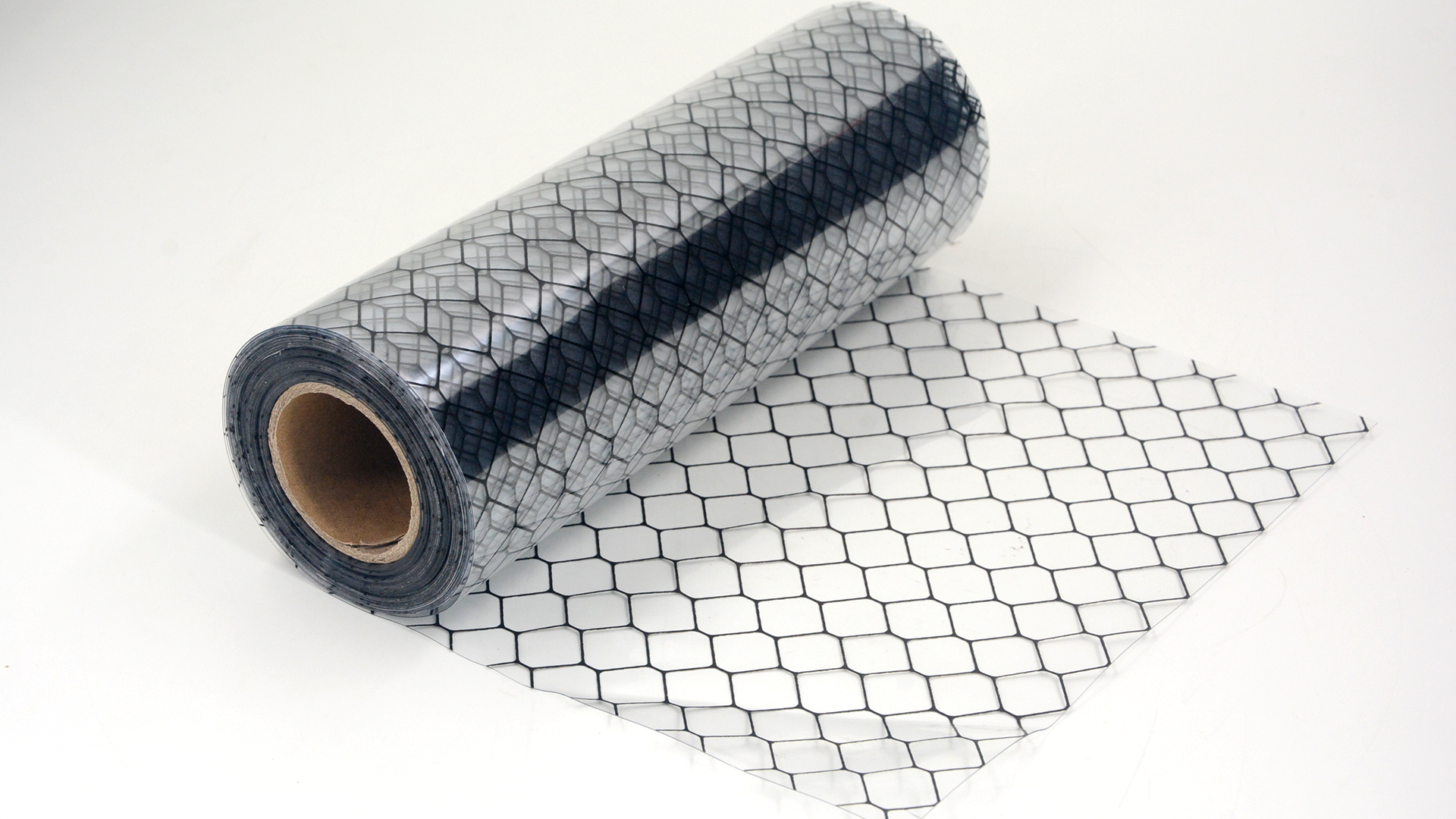
Core working principle – why PVC grid curtains are anti‑static
Plain PVC is a good insulator. In electronics or chemical plants, if ordinary soft curtains are not anti‑static, they can generate very high voltages when people or vehicles pass through, discharging static to products or operators.
The anti‑static grid curtain works by providing a controlled path for charge dissipation:
Conductive grid pattern: Black conductive ink is printed on the PVC film. Surface resistance typically lies between 10⁴ and 10⁶ Ω/□. Charge decay time can be kept below 0.3 seconds, ensuring that any static generated as people and equipment pass through is quickly drained and does not accumulate on the curtain.
Conductive fiber cord / grounding terminals: In more advanced anti‑static curtains, a conductive fiber cord is embedded at the edge as the core grounding element. Copper terminals fix the cord ends, and aluminium profiles are used for mounting, achieving directional static dissipation. This completely eliminates the risk of ESD discharge from the curtain to products.
Multi‑dimensional benefits – much more than static control
Beyond ESD protection, PVC grid curtains excel at environmental control.
| Performance aspect | Typical specification / measured data | Practical value |
|---|---|---|
| ESD anti‑static | Grid surface resistance 10⁴–10⁶ Ω; non‑grid area 10⁸–10¹⁰ Ω | Safely dissipates static, protecting sensitive electronic components |
| Cleanliness & dust control | Particle shedding ≤ Class 1 (ISO 14644); smooth surface, dust‑repellent | Prevents cross‑contamination, helps maintain cleanroom particle counts |
| Temperature stability & energy saving | Operating temperature from –50°C to +60°C; slows air convection by >90% | Reduces energy costs in cold rooms or temperature‑controlled workshops |
| Insect barrier | Insect‑repellent PVC formulation (specific optical or olfactory effect) | Solves insect infiltration problems in food and bio‑pharma factories |
| Safety & transparency | Light transmittance ≥85%; soft material, can be dislodged on impact | Prevents damage from forklifts, improves visibility, reduces accidents |
| Regulatory compliance | FDA food‑contact approval (FDA 21 CFR & EU 10/2011), flame rating UL94 V‑0, RoHS 2.0 | Meets global food safety, fire safety and environmental standards |
Why flame retardancy matters: In high‑value manufacturing environments such as electronics and pharmaceuticals, fire safety is a non‑negotiable red line. Ordinary PVC curtains are not flame‑retardant. If a curtain is ignited by an electrical short circuit, flames can spread rapidly along the material. UL94 V‑0 is the highest flame‑retardant rating for plastics used in industry. It guarantees that the curtain will self‑extinguish within seconds after the flame source is removed, preventing fire from spreading. This is a fundamental protection for factory assets and personnel.
Application guide by industry – six typical scenarios
| Industry | Pain point | Recommended curtain type | Colour / specification | Installation advice |
|---|---|---|---|---|
| Electronics / SMT | Electrostatic damage to chips, high scrap rate | Anti‑static grid curtain (black/transparent grid) | Thickness 0.5–1.0 mm, grid side facing out; resistance ≤10⁶ Ω | Use galvanised or stainless steel tracks, ensure curtain touches floor for closed barrier |
| Pharma / bio‑labs | GMP / FDA audits; risk of cross‑contamination (bacteria, mould) | Anti‑static clear curtain or magnetic sealed curtain | FDA‑grade PVC, no grid, no dirt‑trapping dead corners | Must be transparent to prevent forklift collisions; airtight sealing required |
| Food & beverage | FDA compliance audits, insect ingress, temperature loss (high energy cost) | Insect‑repellent yellow transparent curtain / magnetic sealed curtain | Yellow UV‑blocking PVC (insect‑avoidance spectrum), thickness 0.3–0.5 mm | Install at loading docks and cold‑room passages; magnetic closure maintains thermal seal |
| Chemical / laboratory | Leakage of chemical / solvent fumes, spread of corrosive gases | Chemical‑resistant PVC transparent curtain | Special acid/alkali‑resistant formulation, low‑temperature resistant | Reinforce tracks to prevent curtain being blown open by strong draughts |
| Cleanroom zoning | Frequent personnel / material movement, high risk of cross‑contamination | Soft PVC partition curtain | Large anti‑static / cleanroom curtain, weighted bottom bar | Use aluminium frame to form a soft wall, replacing rigid partitions |
| Warehousing & logistics | Frequent handling, damage by forklifts, loss of temperature zone | Heavy‑duty reinforced industrial curtain with transparent vision panel | Thickness 3–5 mm, embossed reinforcing pattern to resist tearing | Use stainless steel frame with heavy‑duty impact‑resistant tracks |
On‑site verification – how to check quality when you receive samples
Do not rely on visual appearance alone. Perform these simple tests to verify the curtain meets specifications.
Measure resistance – This step is absolutely essential. Use a surface resistance meter. Measure the resistance on the conductive grid (should be 10⁴–10⁶ Ω/□) and on the non‑grid area (should be ≤10¹⁰ Ω). This ensures you are not buying a fake anti‑static curtain that only has a printed grid but no actual ESD performance (no conductive coating or grounding fibre).
Check low‑temperature flexibility – Measure the actual ambient temperature where the curtain will be installed. Standard PVC becomes brittle and cracks below –18°C. For deep‑freeze cold rooms, you must use a special low‑temperature PVC formulation.
Rub / fold test – Vigorously rub or fold the curtain. Look for white “blooming” (exudate) along the fold line. Any white exudate indicates the presence of hazardous plasticisers that do not comply with EU REACH or RoHS regulations.
Flame test – Cut a small corner and try to ignite it with a lighter. A UL94 V‑0 rated curtain will self‑extinguish as soon as the flame is removed. If it continues to burn with thick black smoke and melting drips, the material does not meet the required flame‑retardant standard.
Industry trends and conclusion
This seemingly simple physical partition is quietly delivering enormous hidden value in smart factories and lean manufacturing through “soft control”. By creating micro‑environments within the plant, grid curtains avoid the astronomical electricity bills that would be required to condition the entire cleanroom volume. At the same time, they directly prevent large‑scale product scrap through ESD control and microbial isolation.
In SMT lines that must meet ISO 14644 cleanroom standards, or in any cleanroom where static control and dust prevention are critical, PVC grid curtains offer an economical, efficient and transparent solution. They are less bulky than rigid doors and do not carry the ESD and exudation risks of ordinary plastic strip curtains.
Choosing the right PVC grid curtain reduces energy loss, improves cleanliness, and guarantees ESD safety for electronic components as well as sterile isolation for biological and pharmaceutical processes.
If you need more information about curtain thickness calculations, track hardware, the difference between imported and standard PVC, or real‑world application case studies, please contact us for a free PDF selection guide.