ESD Smocks Work: Not Blocking Static, But Draining It
Ordinary cotton work clothes can generate static voltages of 5000‑10000V in dry environments just from body movement. That is enough to damage CMOS devices.
The core function of an ESD smock is not to prevent static generation but to drain static charge safely. There are two common methods.
| Method | How it works | Typical surface resistance | Pros and cons |
|---|---|---|---|
| Conductive fiber grid | Carbon fibers woven into fabric (5‑10mm spacing) form a conductive network | 10⁶–10⁹ Ω | Stable, washable, long life |
| Anti‑stat coating | Hydroscopic coating applied to fabric surface | 10⁹–10¹¹ Ω | Low cost, but fails after a few washes |
Conclusion For long‑term cleanroom use, choose the conductive fiber grid type (striped or grid style). Coated fabrics are only for short‑term or disposable use.
Six Design Features – What You Should Know
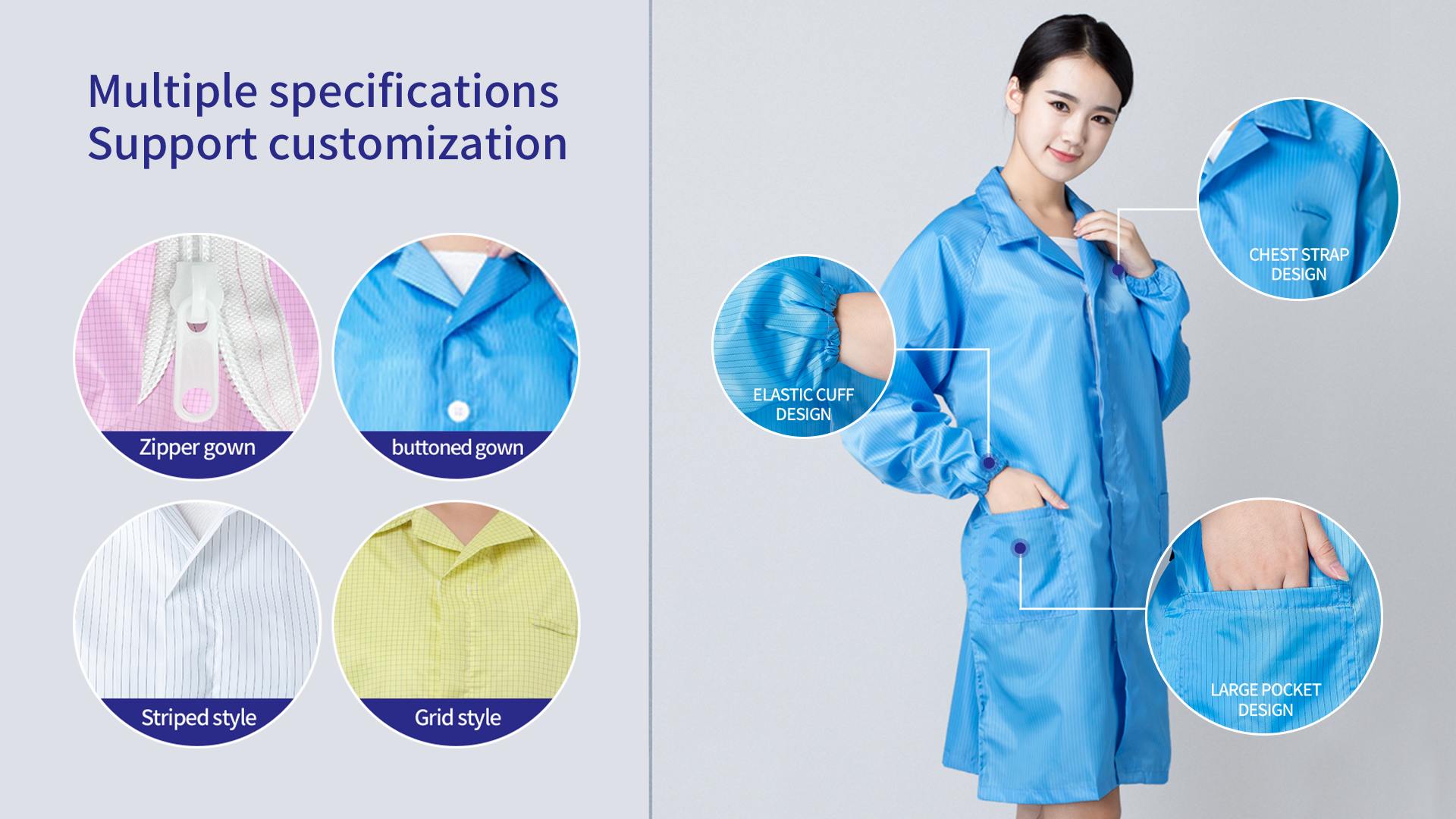
1. Chest Strap Design
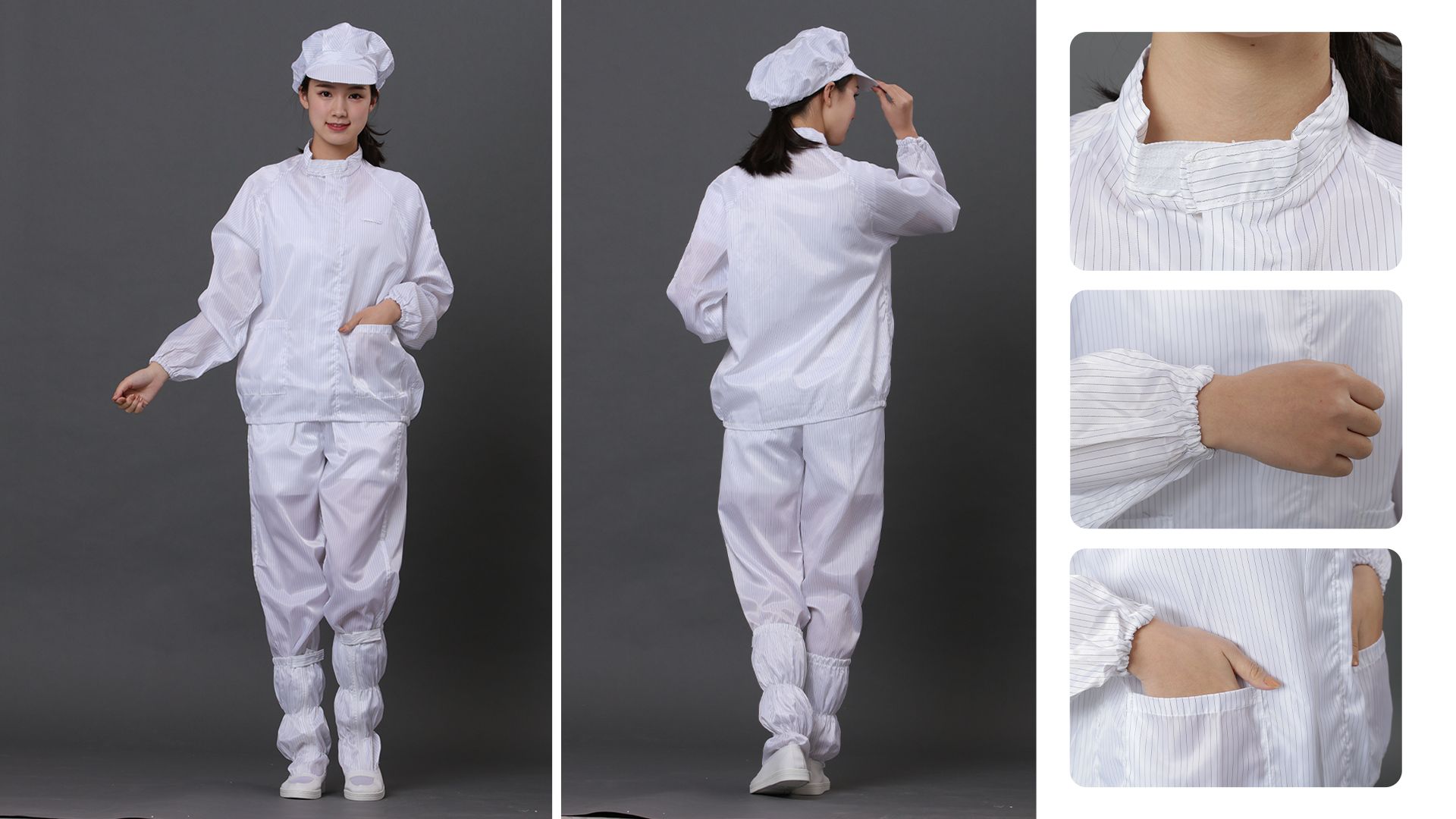
Function Provides a low‑resistance grounding point. The operator can attach a wrist strap ground cord directly to the metal snap on the chest. This equalizes the potential between the garment and the body, preventing static buildup from fabric‑skin friction.
When necessary Required in high‑grade EPA per ANSI/ESD S20.20. Also useful when operators are mobile and cannot stay connected to a wrist strap. The chest strap serves as a backup low‑impedance path.
2. Elastic Cuff Design
Function Tightens the sleeve opening to prevent lint from undergarments or skin from escaping, and reduces static generated by arm movement against work surfaces. Elastic cuffs typically have resistance ≤10⁹ Ω.
Comparison Straight cuffs are loose. When the operator moves arms across a workbench, friction can generate several thousand volts.
3. Large Pocket Design
Function Convenient storage for tools, notebooks, phones. However, pocket placement and lining affect ESD performance.
Good design Pocket lined with conductive fabric, with a flap or zipper closure. Prevents items inside from rubbing against the body.
Poor design Regular non‑conductive lining. A plastic pen or phone moving inside the pocket can generate high static and discharge through the opening to nearby sensitive devices.
Recommendation Choose large pockets with flap or zipper, located below the waist (reduces friction from arm movement).
4. Closure Type: Zipper vs Buttons
| Closure | Advantages | Disadvantages | ESD impact |
|---|---|---|---|
| Zipper (metal or conductive plastic) | Tight seal, no gaps, low particle leakage | Metal zippers could spark (rare) | Recommended: conductive zipper (low resistance) |
| Plastic buttons | Convenient, low cost | Gaps between buttons may leak particles; plastic is insulative | Not recommended for ISO 5 or above |
| Metal / conductive buttons | Conductive, can assist grounding | Metal may scratch equipment | Acceptable for non‑critical areas |
First choice Zipper gown (zipper gown) with outer snap flap (double seal).
5. Striped vs Grid Style
Both are common conductive fiber patterns. Performance difference is small. Main differences are visual and inspection.
| Style | Description | Pros | Cons |
|---|---|---|---|
| Striped | Conductive fibers in parallel lines (10‑20mm spacing) | Slightly lower cost | Less uniform conductivity |
| Grid | Conductive fibers in cross pattern | More uniform surface resistance, easier to spot broken lines | Slightly higher cost |
Recommendation For ISO 5 and above, choose grid style. For ISO 6‑8, striped is sufficient.
6. Waist / Back Adjustment (Chest strap also shown)
Function Adjustable straps at the waist or chest make the smock fit snugly, reducing flapping and friction. Also helps secure the ground cord.
Three ESD Smock Selection Checklist (Printable)
| Feature | Recommended requirement | Reason |
|---|---|---|
| Conductive mechanism | Carbon fiber grid (striped or grid) | Avoid coated fabric |
| Surface resistance | 10⁶–10⁹ Ω (point‑to‑point) | Must meet ANSI/ESD STM2.1 |
| Closure | Zipper + outer snap flap | Double seal, low particle leakage |
| Cuffs | Elastic cuffs | Reduce particle shedding and triboelectric charging |
| Pockets | Conductive lining, flap/zipper, below waist | Prevent static from stored items |
| Ground snap | Chest or waist metal snap (4mm) | Easy wrist strap connection |
| Cleanroom class | Choose fabric according to ISO class (ISO 5+ needs special low‑particle fabric) | Particle shedding ≤1000 particles/m² |
Real Data: Good Design vs Poor Design
We compared two electronics factories. Factory A used grid‑style ESD smocks with chest snap, elastic cuffs, and zipper closure. Factory B used striped smocks without elastic cuffs, without chest snap, and with plastic button closure.
| Test item | Factory A (good) | Factory B (poor) |
|---|---|---|
| Surface resistance (point‑to‑point) | 3–6 × 10⁷ Ω | 8×10⁷ – 2×10⁹ Ω (some fail) |
| Cuff friction voltage (arm wiping bench) | <100 V | 800–1500 V |
| Particle count at front closure (≥0.5μm) | 120 /m² | 850 /m² |
| Resistance drift after 1 year | +12% | +60% (some fail) |
Operators in Factory B reported buttons popping open and phones falling out of pockets. Factory B had to replace all smocks early, costing 30% more than Factory A over two years.