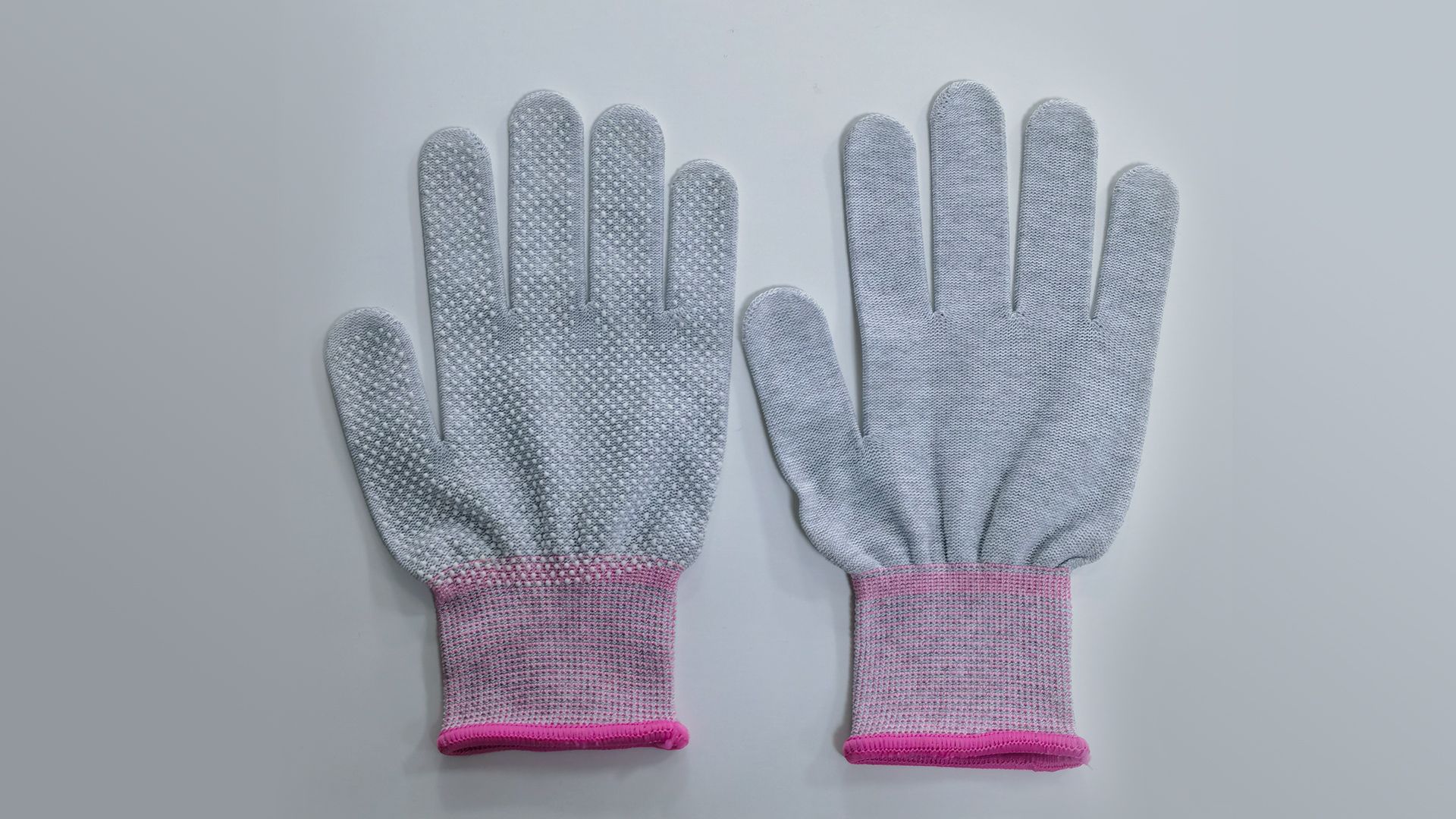
How Knitted Rubber ESD Gloves Drain Static
There are two main mechanisms for making a glove anti‑static.
Conductive fiber blending – Carbon fibers are knitted into nylon or polyester yarns at regular intervals (typically 5‑10mm spacing). This creates a permanent conductive network. These gloves can be washed over 100 times without losing ESD performance. Surface resistance typically stays between 10⁶ and 10⁹Ω.
Conductive coating – PU or nitrile coatings are loaded with conductive fillers. The coating itself becomes dissipative. However, as the coating wears off, ESD performance degrades. These gloves are best for applications where grip and light chemical resistance are also needed.
The acceptable resistance range for ESD dissipative gloves is generally 10⁶ to 10⁹Ω per ANSI/ESD S20.20. Below 10⁶Ω may cause rapid discharge. Above 10⁹Ω does not drain static effectively.
Material and Coating Comparison
Three common types of knitted rubber ESD gloves are available. Each has different properties.
| Type | Material | ESD mechanism | Typical resistance (Ω) | Key characteristics |
|---|---|---|---|---|
| Nitrile coated | Synthetic rubber | Coating with conductive filler | 10⁶–10⁸ | High puncture resistance, chemical resistant, no latex allergy risk |
| PU coated | Polyurethane on nylon/carbon liner | Dissipative coating + conductive liner | 10⁶–10⁹ | Excellent dexterity, breathable back, good for precision work |
| Latex / natural rubber | Natural rubber with carbon | Conductive filler or fiber | 10⁶–10⁹ (if ESD grade) | High elasticity, comfortable, but allergy risk and poor chemical resistance |
PU coated anti‑static gloves are the most common choice for PCB assembly and precision optics because they combine low particle shedding with good tactile sensitivity. Nitrile coated gloves are preferred when operators handle oils, solvents, or sharp components.
Resistance Data and What It Means
We compiled resistance data from factory audits of knitted rubber ESD gloves in daily use. The measurements followed ANSI/ESD STM11.11 (point‑to‑point on the palm coating).
| Glove type | New glove resistance (Ω) | After 3 months (Ω) | After 6 months (Ω) | Pass/fail criterion (10⁶–10⁹) |
|---|---|---|---|---|
| PU coated on carbon liner | 2–5 × 10⁷ | 4–8 × 10⁷ | 6–9 × 10⁷ | Pass |
| Nitrile coated (standard ESD) | 3–7 × 10⁷ | 5–9 × 10⁷ | 1–3 × 10⁸ | Pass (marginal after 6 months) |
| Latex ESD (carbon blended) | 5–9 × 10⁷ | 1–2 × 10⁸ | 2–5 × 10⁸ | Pass but drifting higher |
Gloves with conductive fiber blended into the liner maintain stable resistance much longer than those relying solely on coating. For long‑shift use, carbon‑fiber knitted gloves are more reliable.
How to Choose Based on Application
| Application | Recommended glove type | Coating coverage | Why |
|---|---|---|---|
| PCB assembly, SMT pick‑and‑place | PU coated on carbon liner | Palm and fingers | Good dexterity, low particle, stable ESD |
| Semiconductor wafer handling | Carbon fiber blended (uncoated or light PU) | Fingertips only | Maximum tactile feel, lowest particle |
| Repair and rework | Nitrile coated | Full palm | Chemical resistance, puncture resistance |
| Logistics and kitting (non‑critical) | Latex ESD or economy PU | Palm | Lower cost, acceptable for less sensitive areas |
Lifespan and Washing
Reusable knitted rubber ESD gloves typically last 3‑6 months with daily use. The main failure modes are coating wear, dirt buildup on the surface, and broken conductive yarn.
For washing to extend life, follow these rules.
Use cold water (30°C max). Use mild neutral detergent. Do not use fabric softener or bleach. Do not use dryer sheets. Air dry or tumble dry low.
Gloves with carbon fiber liners can be washed over 100 times without significant resistance change. Coated gloves lose ESD performance after about 20‑30 washes as the coating thins.
Key Metrics to Request from Suppliers
When purchasing knitted rubber ESD gloves, ask for the following data.
Surface resistance range – should be clearly stated as 10⁶–10⁹Ω per ANSI/ESD STM11.11.
Conductive mechanism – carbon fiber blended or coated. Blended is more durable.
Particle shedding – for cleanroom use, request IEST‑RP‑CC005.4 data. Good gloves shed less than 2000 particles per glove (≥0.5μm).
NVR and ionic residues – for semiconductor or optical applications, NVR should be below 0.1 mg per glove. Sodium and chloride ions below 1.0 μg per glove.
Washability – number of recommended wash cycles before resistance drifts out of range.