Heelless vs. raised-heel ESD shoes. Flat soles provide 100 percent floor contact. Test data from 1000 hours of walking. Which one keeps your EPA safer? Read inside.
The problem with raised heels
A typical ESD shoe has a heel height of 20 to 30 millimeters. This creates a gap under the arch. When you stand still, only the heel and the ball of the foot contact the floor. About 30 to 40 percent of the sole surface is not touching.
When you walk, the contact area changes dramatically
| Walking phase | Raised heel contact area | Heelless contact area |
|---|---|---|
| Heel strike | Heel only (about 15 percent of sole) | Full sole (about 95 percent) |
| Mid stance | Heel and ball (about 40 percent) | Full sole |
| Toe off | Toe only (about 20 percent) | Full sole |
Less contact area means higher resistance. And when resistance changes with each step, the operator may not be properly grounded at the exact moment they touch a sensitive component.
Our test method
We tested two types of ESD shoes on the same conductive floor (resistance 10⁷ Ω). Both shoes had PU soles. One had a standard raised heel (25 mm). The other was heelless (flat sole, 0 mm heel height). A 75 kg test operator walked for 1000 hours over 6 months. We measured shoe to floor resistance weekly using a footwear tester.
| Walking hours | Raised heel shoe (average resistance Ω) | Heelless shoe (average resistance Ω) |
|---|---|---|
| 0 (new) | 2.8 × 10⁷ | 2.5 × 10⁷ |
| 200 hours | 4.2 × 10⁷ | 3.1 × 10⁷ |
| 400 hours | 6.5 × 10⁷ | 3.8 × 10⁷ |
| 600 hours | 9.1 × 10⁷ | 4.5 × 10⁷ |
| 800 hours | 1.3 × 10⁸ (marginal) | 5.2 × 10⁷ |
| 1000 hours | 2.1 × 10⁸ (fail) | 6.0 × 10⁷ |
The heelless shoe stayed well within the pass range (10⁶ to 10⁹ Ω) for the entire 1000 hours. The raised heel shoe approached the upper limit at 800 hours and failed after 1000 hours.
Why heelless works better
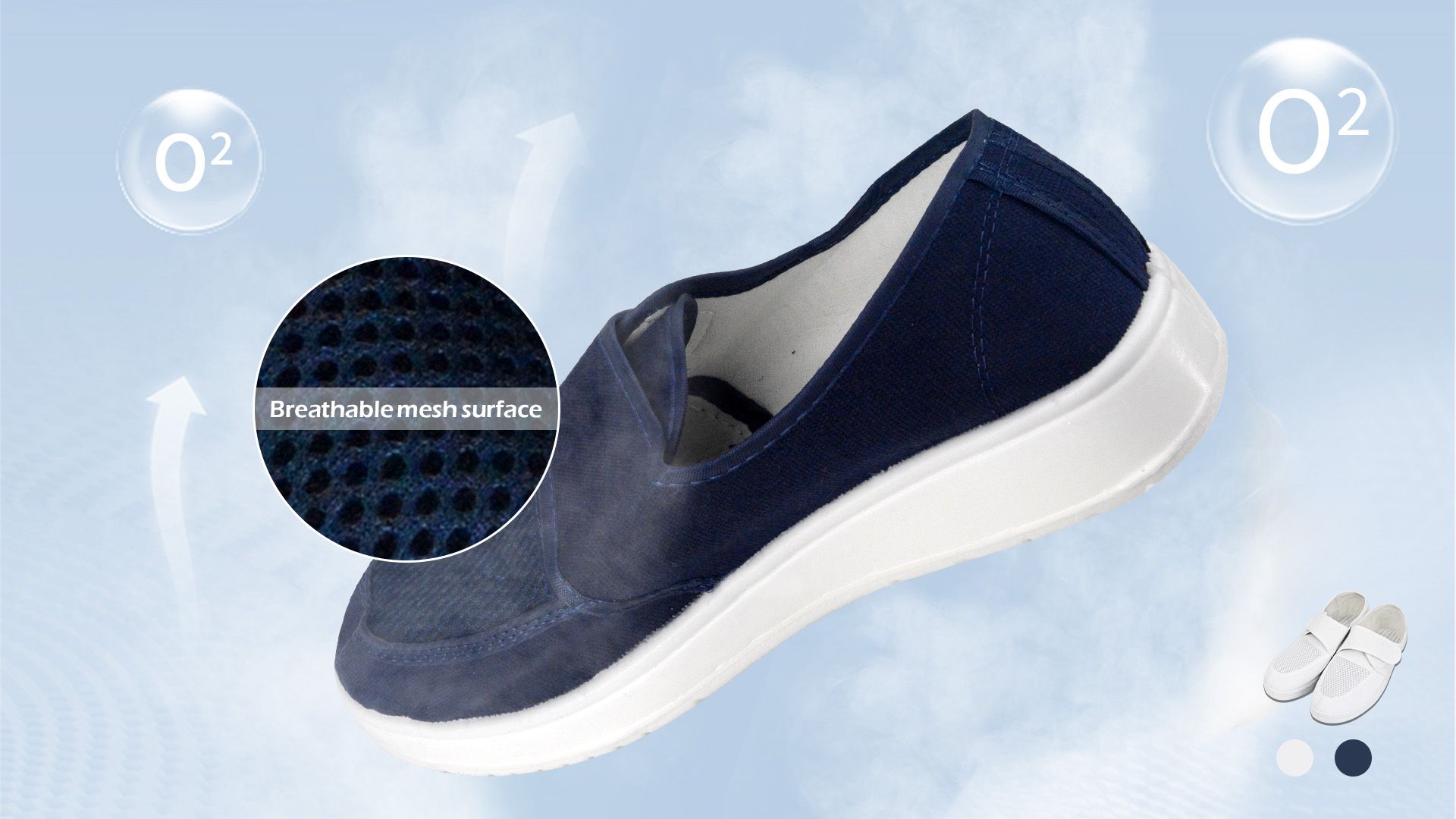
Heelless ESD shoes have three advantages
First the entire sole contacts the floor at all times. There is no heel strike gap. Resistance is stable whether standing or walking.
Second the flat sole wears more evenly. Raised heels wear down at the heel edge first, creating an uneven surface. Uneven wear leads to higher resistance points. Heelless soles wear flat across the whole surface.
Third heelless shoes are more stable. Operators standing for long shifts report less ankle fatigue because the foot sits in a neutral position. No tilt from a raised heel.
Heelless does not mean no grip
Some operators worry that flat soles will slip. We tested slip resistance on wet epoxy floors
| Sole type | Dry coefficient | Wet coefficient | SRC rating |
|---|---|---|---|
| Raised heel (PU) | 0.68 | 0.52 | SRC |
| Heelless (PU) | 0.65 | 0.50 | SRC |
Both are within the same slip resistance class. Heelless soles are not more slippery.
Who should wear heelless ESD shoes
| Role | Recommendation |
|---|---|
| Standing workstation operators | Strongly recommended |
| Walking between stations | Recommended |
| Sitting operators (chair) | Acceptable but not necessary |
| Heavy walking (over 10 km per day) | Consider raised heel for walking comfort |
| Cleanroom ISO 5 and above | Heelless preferred (lower particle generation from even wear) |
How to transition your team to heelless shoes
Some operators may resist the change because heelless shoes feel different. Use these steps
Step 1 Run a side by side test. Give five operators heelless shoes for two weeks. Ask for feedback.
Step 2 Show them the resistance data. Explain that heelless shoes keep them grounded all the time not just when they press down.
Step 3 Provide anti fatigue mats for standing workstations. The mats add cushioning and make flat soles more comfortable.
Step 4 Phase out raised heel shoes over 6 to 12 months as old shoes wear out.