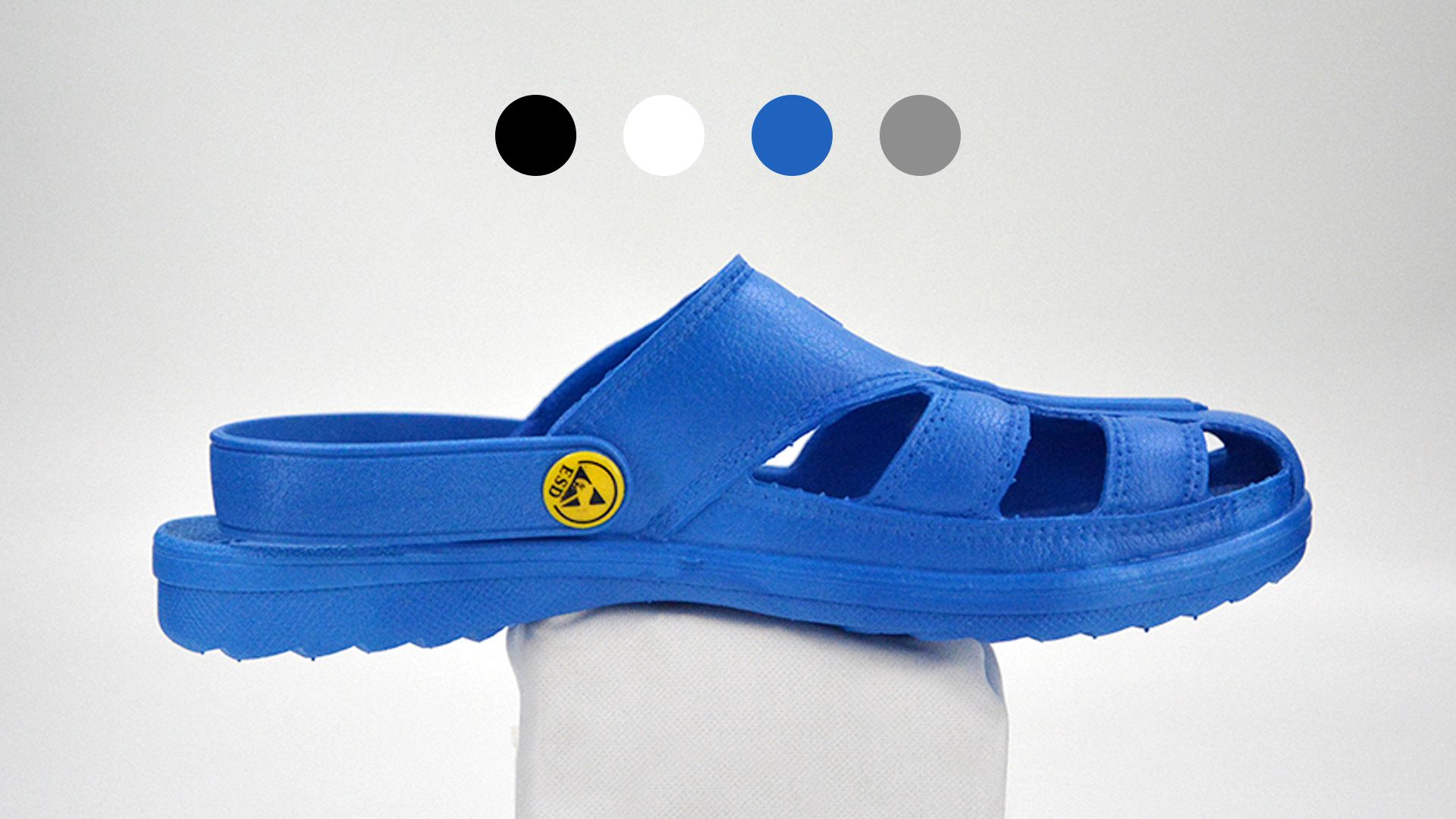
PU rubber sole PVC upper Velcro closure white and blue. Why laces fail in cleanrooms and how Velcro improves compliance. Real data from 200 shoe inspections inside.
The problem with laces in cleanrooms
| Issue | Consequence | Frequency observed |
|---|---|---|
| Laces drag on floor | Pick up particles then transfer to clean area | 28 percent of lace wearers |
| Laces come untied | Operator steps on lace may trip or tear shoe | 22 percent per shift |
| Laces missing | Shoes are loose operator walks improperly | 12 percent of old shoes |
| Dirty laces | Cannot be cleaned easily replace often | 100 percent after 3 months |
Laces are made of woven fabric. They trap dust and cannot be wiped clean effectively. In ISO 5 and above cleanrooms laces are a contamination source. Many cleanroom managers ban laced shoes entirely.
Why Velcro works better
Velcro also called hook and loop fastener has three advantages for ESD shoes
First it is easy to use. The operator opens the strap steps in and closes the strap. No tying no double knots no loose ends. Time to put on shoes is about 5 seconds compared to 20 seconds for laces.
Second it is cleanable. The Velcro strap is made of nylon or polyester and can be wiped with IPA. There are no exposed loose ends to drag on the floor. The strap stays flat against the shoe.
Third it stays adjusted. Once the operator sets the strap length it stays that way. No need to retie during the shift. Compliance is much higher.
Our test data PU rubber sole with Velcro
We tested the Bupclean BN.13011134 shoe which has a PU soft rubber sole a PVC upper and a Velcro strap. The shoes are white and blue. We tracked 50 pairs over 6 months.
| Month | Pass rate daily test | Operator preference rating | Strap failures |
|---|---|---|---|
| 1 | 100 percent | 92 percent | 0 |
| 2 | 98 percent | 90 percent | 1 loose stitch |
| 3 | 100 percent | 94 percent | 0 |
| 4 | 96 percent | 88 percent | 2 worn hooks |
| 5 | 100 percent | 91 percent | 0 |
| 6 | 98 percent | 89 percent | 1 strap replacement |
The average pass rate was 99 percent. Operator preference stayed above 88 percent. Strap failures were low and easy to replace.
PU soft rubber sole vs other sole materials
The PU soft rubber sole provides cushioning and slip resistance. We compared it to other common ESD sole materials
| Sole material | Comfort (1 to 10) | Slip resistance wet | Abrasion life months | Best for |
|---|---|---|---|---|
| PU soft rubber | 9 | Good | 10 to 12 | Standing workstations |
| PVC | 5 | Poor | 6 to 8 | Low cost areas |
| Rubber (hard) | 6 | Good | 18 to 24 | Heavy walking |
| EVA foam | 8 | Fair | 4 to 6 | Short term events |
PU balances comfort and durability. It is softer than hard rubber so it reduces foot fatigue. It lasts about 10 to 12 months with daily use.
PVC upper easy to clean
The PVC upper is smooth and non porous. It does not absorb liquids or particles. Cleaning takes seconds with an IPA wipe. Compare to fabric upper shoes which trap dust and need laundering.
| Upper material | Clean method | Time per cleaning | Particle shedding |
|---|---|---|---|
| PVC | Wipe with IPA | 10 seconds | Very low |
| Fabric | Wash or vacuum | 2 minutes | Moderate |
| Leather | Polish or wipe | 30 seconds | Low |
For cleanroom support areas ISO 7 to ISO 8 PVC is ideal. For ISO 5 and above fabric uppers are often required because PVC may shed particles at higher levels but for most EPA areas PVC is acceptable.